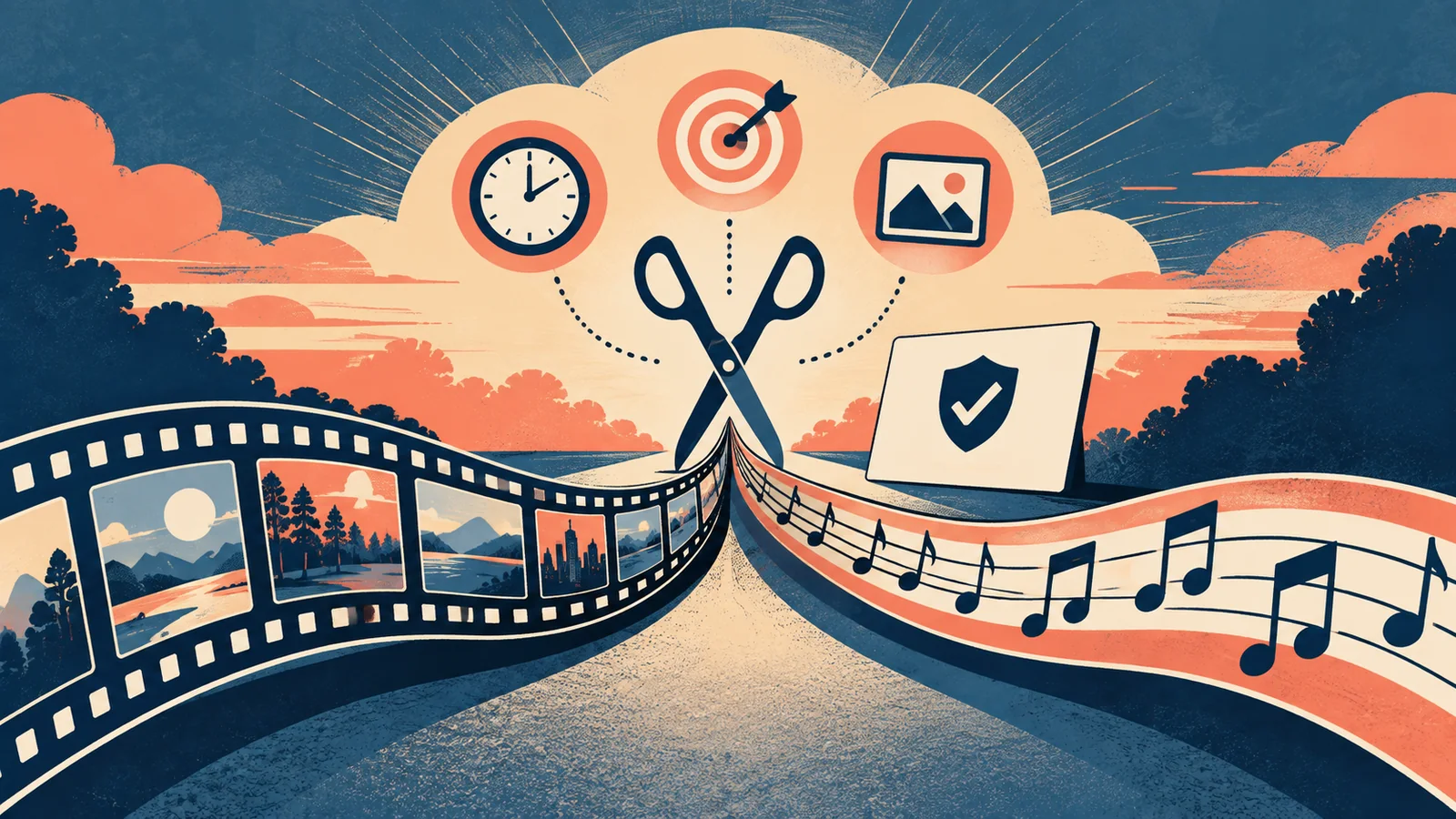
Choose music early when it defines the action, timing or performance you must capture. Choose it after the rough cut when the story, explanation or evidence must determine duration. Most creator videos need a hybrid: edit the truthful structure first with a temporary rhythm reference, then license and shape final music before fine cutting.
The decision is not about taste. It is about which element is allowed to set the timeline, and how much rework or rights risk you can accept.
Name the story authority
Ask what cannot be bent without harming the piece:
- Instruction: steps must remain complete and understandable.
- Interview or testimony: meaning and honest context control the cut.
- Demonstration: observable action and proof determine screen time.
- Performance: movement, choreography or musical phrasing is the event.
- Montage: emotional arc and visual rhythm may be led by music.
- Advertisement: approved claims, disclosure and fixed duration constrain both.
The element with authority should be established first. If spoken reasoning carries the value, forcing it into a preselected drop can remove necessary context. If a dance or reveal must land on musical structure, postponing music makes the capture plan incomplete.
Write one sentence: “The viewer must understand/feel/see ___ even if the music changes.” That sentence protects the edit when a track becomes seductive.
Use a decision matrix
| Project condition | Choose music early | Choose music after rough cut | Hybrid |
|---|---|---|---|
| Choreography or lip-sync | Strong fit | Poor fit | Possible with fixed reference |
| Dialogue-led explanation | Risk of forced pacing | Strong fit | Usually strongest |
| Fixed-duration montage | Useful | Possible rework | Strong fit |
| Documentary testimony | Can bias selection | Strong fit | Use neutral temporary pulse |
| Product reveal tied to beat | Strong fit | Requires restructuring | Strong fit if cue points are planned |
| License uncertainty | High rework risk | Structure remains portable | Use cleared temp or abstract markers |
| Multiple stakeholder music tastes | Premature lock risk | Story can be approved first | Approve direction before final track |
This table recommends an order, not a rule. A 20-second tutorial and a 20-second fashion montage have the same duration but different authorities.
What “music first” should mean
Music-first does not mean dragging a favorite song under random footage. It means a rights-screened track or musical structure informs pre-production.
Before capture, mark:
- phrase starts and endings;
- energy changes;
- usable edit points;
- required clean ending;
- exact duration and alternate versions;
- moments where action must be recorded at a particular speed;
- space needed for speech, disclosure and sound effects.
Build a shot plan around those functions. Capture handles around each action rather than only the precise beat. Handles preserve the option to retime or replace the track without losing the shot.
Music-first is strongest for performances, repeated movements, timed reveals and visual sequences whose meaning does not depend on compressing an argument.
What “rough cut first” should mean
Create a radio or meaning cut before decorating it. Select the statements, actions and proof that the viewer needs, then remove repetition and establish a truthful order. Use production sound, room tone and temporary silence to judge whether the piece works without emotional assistance.
Do not polish transitions yet. The rough cut should answer:
- Is the promise delivered?
- Is each claim supported by picture or context?
- Can a new viewer follow the sequence?
- Where does energy naturally rise or fall?
- What is the minimum honest duration?
Once this structure is stable, brief music against actual functions: support concentration, bridge a transition, lift a reveal, create a clean ending or withdraw for an important statement.
Rough-cut-first is strongest for interviews, education, reviews, documentary material and any video where shortening a sentence to meet a beat could change its meaning.
Use a hybrid without falling in love with the temp track
A hybrid workflow establishes story beats first but uses a temporary rhythm reference before final timing. The reference may be a cleared library preview used within its trial terms, a licensed guide track, a click track you created or non-musical markers.
Label every temporary asset visibly in the project and export name. Record:
- source and permission status;
- whether it may appear in internal reviews;
- tempo or structural function being referenced;
- replacement deadline;
- who owns final clearance.
Do not let stakeholders approve the temp track by accident. Watermark the review or place “TEMP MUSIC — NOT CLEARED” in the review notes. A client hearing the same cue through many rounds can mistake familiarity for necessity.
Cut to structural markers—intro length, pulse, break, rise, ending—not to every transient. This allows several final tracks with similar functions to fit without rebuilding the sequence.
Clear rights before the edit depends on a track
The U.S. Copyright Office distinguishes the musical composition from the sound recording. Owning an audio file, finding a song on a platform or recording a cover does not by itself establish all permissions needed to combine music with video.
Before a track becomes structurally expensive to replace, confirm:
- exact track, version and asset ID;
- licensee and licensor;
- audiovisual use and intended platforms;
- monetized, sponsored, client and paid-ad scope;
- territory, term and publication window;
- cutdowns, translations and later revisions;
- attribution or registration duties;
- what happens after subscription cancellation;
- evidence and claim-response process.
For a high-dependency music-first piece, complete this screen before filming. For rough-cut-first work, complete it before fine-cut approval. Never schedule final delivery on the assumption that a track will probably clear later.
Brief music from the timeline
Replace mood-only requests with timed functions:
| Time | Editorial function | Music requirement |
|---|---|---|
| 00:00–00:04 | State the problem | Immediate identity, no long intro |
| 00:04–00:18 | Explain two steps | Low density under speech |
| 00:18–00:23 | Show result | Perceptible lift without masking sound |
| 00:23–00:27 | Final instruction | Reduce or simplify |
| 00:27–00:30 | End card | Clean ending, not a fade forced mid-phrase |
Include elements to avoid: vocals under dialogue, comic tone, aggressive percussion, sentimental harmony or a frequency-dense lead. A functional brief creates faster, more defensible shortlists.
Test candidates at the correct listening level under real dialogue. A track that feels exciting solo may make narration harder to understand or pressure the editor into unnecessary cuts.
Protect sync points by rank
Not every beat deserves a visual event. Rank sync points:
- A points: story turns, reveals, chapter changes and ending.
- B points: useful shot changes or graphic entries.
- C points: decorative micro-cuts.
Lock A points first. Use B points only when the image has new information. Leave C points unsynchronised unless the format intentionally calls for dense rhythmic editing.
This prevents the track from fragmenting speech or shortening proof. The viewer should notice coherent momentum, not the editor’s ability to hit every beat.
Compare candidates in context
Duplicate a short sequence and place two or three rights-screened tracks under the same edit. Match playback level enough for a fair comparison; louder often feels more impressive. Review each version for:
- speech intelligibility;
- emotional truthfulness;
- pace pressure;
- compatibility with natural sound;
- quality of transitions and ending;
- number of structural recuts required;
- license and evidence fit.
Ask reviewers what changed in the meaning, not which song they “liked.” A candidate that turns a careful explanation into triumph or a serious account into lifestyle decoration may be musically attractive and editorially wrong.
Know the cost of choosing at the wrong time
Music chosen too early can create:
- forced sentence cuts;
- missing demonstrations;
- unnecessary reshoots;
- emotional bias before the story is understood;
- replacement risk when rights fail.
Music chosen too late can create:
- action that never aligns with necessary cue points;
- an ending with no musical resolution;
- stakeholder disagreement after picture lock;
- expensive retiming of graphics and sound design;
- missed opportunities to capture music-dependent performance.
Use these costs to choose the workflow. The question is not “Which order is professional?” It is “Which dependency is most expensive to discover late?”
Set approval boundaries
Use separate approvals:
- story or radio cut;
- music direction and rights scope;
- final track shortlist;
- fine cut with music;
- mix and final evidence package.
If the brand or client can reject music, obtain direction approval before picture lock. Define how many track searches and music-driven recuts are included. A request to replace an approved track after fine cutting is not the same as a minor volume note.
Archive the music-free master, selected license, invoice or certificate, terms snapshot, project registration and final publication URL together. This preserves the option to replace music for a new territory, campaign or platform.
Final review without music
Mute the music once before release. Confirm that dialogue, natural sound, captions and visual sequence still convey the necessary information. Then restore music and check:
- it does not mask speech or required audible cues;
- the emotional frame remains truthful;
- disclosures are not rushed or buried;
- important action has enough screen time;
- the ending feels intentional;
- the exported track is the licensed version;
- the evidence package matches the final use.
If the video collapses when music is muted, decide whether that dependence is intentional. A montage may need it; a safety instruction should not.
Release gate for the timing decision
Lock the music workflow only when:
- the story authority is named;
- music-first, rough-cut-first or hybrid is justified by project dependency;
- temporary music is labelled and permitted for its use;
- rights are cleared before replacement becomes expensive;
- the brief identifies timed functions, not mood alone;
- A-level sync points protect story and proof;
- candidates were compared under real dialogue at fair levels;
- approval and revision boundaries are explicit;
- a music-free master and complete evidence packet will be archived.
Choose music at the point where it can shape the video without overruling it. The right order is the one that protects meaning, permissions and the most expensive dependency.
Related resources
Sources and scope
- U.S. Copyright Office — Musical Compositions and Sound Recordings — official authority; accessed 2026-09-14.
- YouTube Help — Use music and sound effects from the Audio Library — official platform documentation; accessed 2026-09-14.
The authority test, hybrid workflow and sync-point ranking are Angry Media editorial synthesis. Music permissions depend on the exact recording, composition, agreement and intended use; seek qualified advice for material uncertainty. Source review completed 2026-09-14; scheduled publication 2026-10-26.
Once the workflow is chosen, creators can review a disclosed catalogue option in the STIS creator music overview
Priority Scorecard