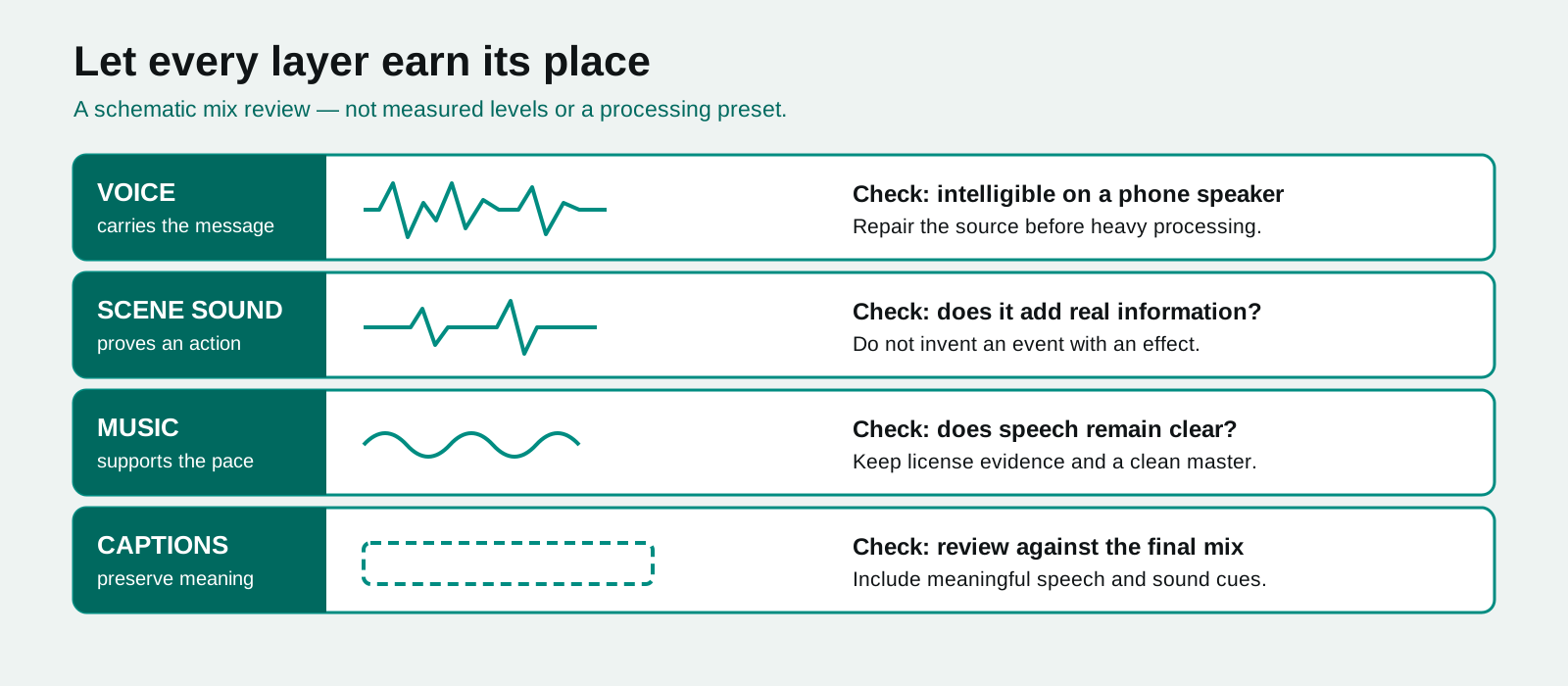
Audio editing for creator video is mostly the work of preserving intelligibility. A clean picture cannot compensate for speech hidden by distance, noise, music or inconsistent levels. Start with the source recording, build the mix around the message and use processing only when it makes the actual listening experience clearer.
Identify the roles in the timeline
Label the tracks before changing anything:
- dialogue or narration;
- production sound from the scene;
- music;
- designed effects;
- ambient room tone;
- captions or transcript reference.
This separation lets you answer a practical question: what would the viewer lose if this layer were removed? If music and effects both merely fill silence, one may be enough. If a click proves the step shown on screen, preserve it.
Repair the recording before processing
Listen through headphones for plosives, clipping, room echo, hum, traffic, handling noise and inconsistent microphone distance. Mark problems, then decide whether the best fix is a replacement recording, a cutaway, a quieter section or modest processing.
Do not apply aggressive noise reduction to every clip. It can remove speech detail or create artifacts. Compare before and after at the level a viewer will use. A less polished but natural voice may be more understandable than an overprocessed one.
Build dialogue continuity
Edit pauses and breaths only when they interrupt meaning or pace. Leave enough room for a sentence to land. Match adjacent clips by level, tone and background ambience so edits do not sound like a jump between rooms.
Use room tone carefully to bridge cuts. Repeating a short loop can become audible; vary it or use a longer section where possible. If the cut changes a fact or sentence meaning, solve it editorially instead of hiding it with ambience.
Add music as support, not cover
Choose music after the spoken structure works. Assign a role: pulse, emotional context, transition or reveal. Bring the track in quietly under dialogue and automate it down around dense phrases. Test on phone speakers, where midrange competition is especially obvious.
Record the source and license for every track. Platform-added music should remain in a platform-specific delivery version, while the project retains a clean master. A good mix that cannot be reused lawfully is an expensive dependency.
Use effects to confirm actions
Production sound can make a screen tap, tool action or physical change credible. Designed effects can emphasize a transition, but they should not invent an event the video did not show. Match loudness and perspective; a close, bright effect on a distant image can feel artificial.
Silence is an editing tool as well. It can create room before a reveal, let a viewer inspect a visual detail or distinguish a serious statement from the surrounding pace.
Captions are part of audio review
Correct captions while listening to the final mix, not only the raw voice. W3C guidance describes captions as text for speech and relevant non-speech audio. Include important speaker identity, sound cues and changes that are not obvious visually. Captions do not make muffled dialogue acceptable, but they reveal wording errors before publication.
Keep a transcript or caption file where possible. It supports corrections, search, translation and repurposing.
Test the finished mix
Run four checks:
- headphones for noise and edits;
- phone speaker at moderate volume for speech masking;
- muted playback for caption accuracy and visual independence;
- a noisy room for whether the main instruction survives.
Avoid relying on one universal loudness target unless the destination and measurement process are controlled. Platforms can process audio. The useful goal is unclipped, consistent and intelligible playback with enough headroom for encoding.
Maintain a mix record
Archive voice and music stems, clean master, final export, asset licenses and a note about unusual processing. If a claim, correction or alternate platform version appears, the project can be repaired without guessing which layer created the problem.
The core audio-editing decision is simple: every sound must either carry meaning, prove an action or deliberately shape attention. Everything else is a candidate for removal.
For creators who need a lawful music source after this mix review, see STIS creator music overview
Quality Checklist